..designed for long-haul stability, capacity and operational resilience
CanAm Airways is built around proven widebody aircraft platforms with a clear focus on reliability, payload capacity and long-term operational stability.
The fleet strategy centers on Boeing 747-400 aircraft, selected for their unique combination of range, structural robustness and large-volume capability. Rather than optimizing for fleet modernity alone, CanAm optimizes for system resilience.
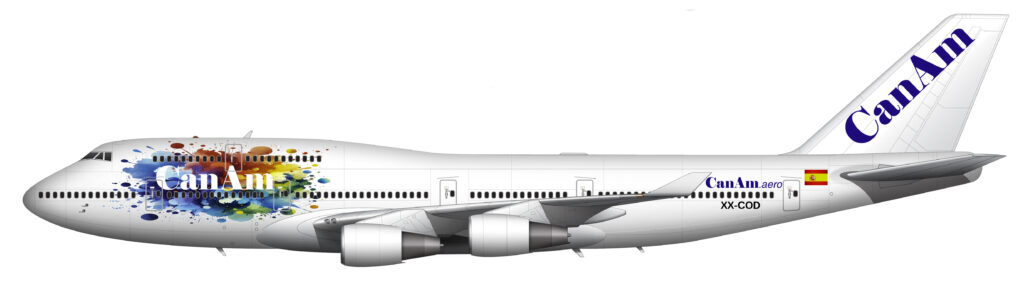
Widebody aircraft with four-engine redundancy provide operational flexibility on long overwater segments (ETOPS), allow higher dispatch reliability in remote regions and offer unmatched cargo capacity alongside premium passenger configurations.
A pragmatic aircraft strategy
By utilizing available pre-owned aircraft, CanAm significantly reduces entry capital expenditure while gaining access to mature maintenance ecosystems, established spare part supply chains and well-understood operational behavior.
This approach enables:
• lower acquisition costs
• faster fleet availability
• predictable maintenance planning
• scalable expansion pathways
The aircraft are configured for comfort-oriented layouts, including business-class-dominant seating concepts on selected routes.
Engineering-driven decisions
Technical choices are guided by measurable performance parameters:
• payload versus range characteristics
• cargo volume per flight
• dispatch reliability
• maintenance accessibility
• environmental footprint per transported unit
Each element is evaluated as part of a system — not in isolation.
Cargo as an integrated component
Cargo operations are not treated as secondary revenue.
The 747 platform enables structurally meaningful freight capacity, particularly on transatlantic and Africa-bound routes, creating a dual-use aircraft architecture that supports both passenger and logistics markets.
Environmental perspective
Environmental impact is assessed per transported passenger and per ton of cargo, rather than per aircraft movement.
High-capacity aircraft combined with optimized routing and reduced fleet fragmentation allow competitive emissions performance on a system level.