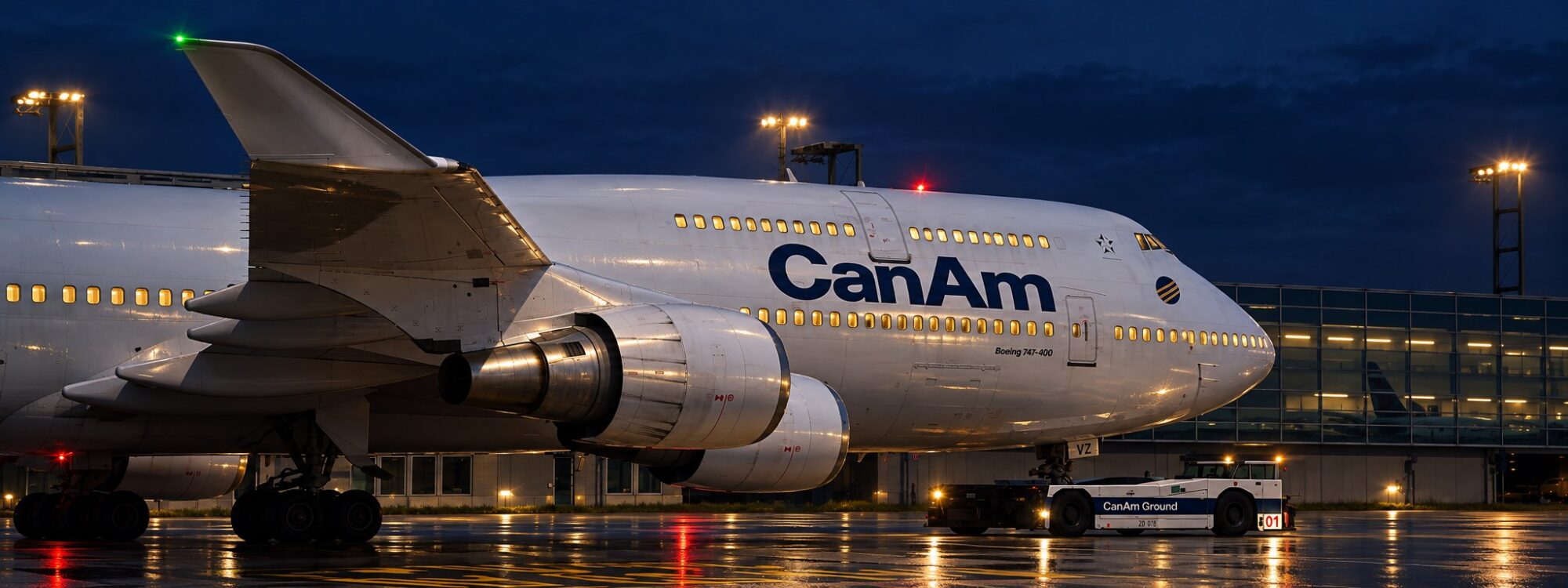
Why True Widebody Comfort Matters
At CanAm, the Boeing 747 is not part of the vision because of nostalgia alone – although it remains the undisputed icon of long-haul aviation. It represents something increasingly rare in modern air travel:
Space that Breathes.
And CanAm’s planned ACMI launch phase begins with the Airbus A340-600, itself also a true long-haul widebody. As the platform progresses toward its own controlled fleet, the Boeing 747-400 is intended to assume a central role.
Different aircraft. The same principle.
Long-haul passengers deserve a genuine long-haul cabin.
Space Changes the Journey
CanAm is not planning to fill these aircraft with the maximum number of seats they can physically accommodate:
There is no conventional Economy Class.
Instead of compressing passengers into ten-abreast seating, CanAm uses the scale of the aircraft to create a cabin in which comfort is structural rather than cosmetic.
The proposed cabin concept combines:
- a large exclusive First Class
- a spacious 2 – 4 – 2 Atlantic Class configuration
with appr. 39 inches of seat pitch - two aisles throughout the main cabin
- generous recline seats and personal space
- room to stand, stretch and move during the flight

Planned Layouts of the CanAm B747-400 Versions with a large first Class and Atlantic Class throughout. Final cabin layouts will be subject to engineering development, certification and aircraft-specific requirements.
Some Say It’s Old. We Say It’s Iconic.
Aircraft age alone says very little about quality.
Technical condition, maintenance history, refurbishment, engine support, cabin design and operating economics matter far more than the date printed on the manufacturer’s plate.
Any aircraft entering CanAm service will be subject to comprehensive technical evaluation, maintenance planning, regulatory approval and an exacting refurbishment program for a complete overhaul.
The economic advantage of an established widebody also allows capital to be invested
where passengers can actually experience it:
- in spacious seating
- in cabin comfort
- in service
- and of course – in reliability
- throughout the complete journey
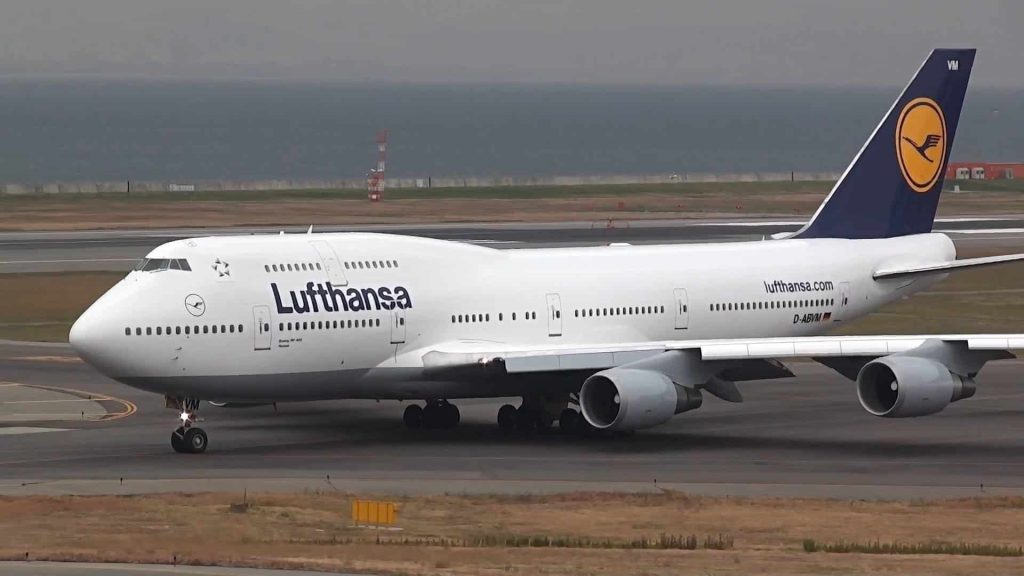
Most airlines have replaced the Queen of the Skies with smaller aircraft and narrower ambitions.
Lufthansa has not. It even acquired more Boeing 747s. Lufthansa operates the largest Boeing 747 fleet worldwide. For good reason.
CanAm sees an opportunity to give this exceptional aircraft a new role through its new, exceptional network.
Range With a Purpose
The Boeing 747-400 offers intercontinental range, substantial payload capability and the flexibility to serve CanAm’s Atlantic network without forcing the aircraft to the edge of its performance envelope.
For CanAm, range is not about flying passengers for as many uninterrupted hours as technically possible.
It is about connecting major North American catchment areas with Gran Canaria, supporting onward African sectors and carrying passengers, baggage and cargo within the same widebody platform.
The aircraft has the reach.
CanAm gives that reach a new purpose.
A Cabin With Character
The volume of the Boeing 747 creates possibilities that smaller, single aisle aircraft simply cannot reproduce.
Its main deck provides the space required for a generous premium cabin, while the upper deck offers an unusually private and distinctive environment for First Class and other exclusive passenger areas.
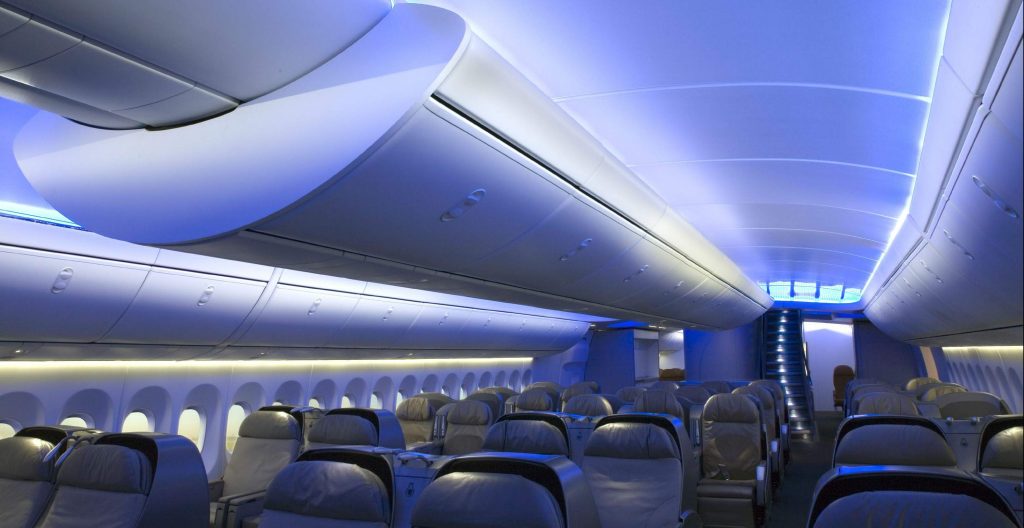
Thoughtful lighting, quieter service, comfortable seating and clearly separated cabin zones can create the atmosphere of an elegant lounge in the sky – without turning the aircraft into a collection of costly gimmicks.
Luxury does not need to shout.
Sometimes it is simply the ability to recline, breathe, move and arrive without feeling that the aircraft was designed around somebody else’s spreadsheet.
A Different Sense of Scale
A large aircraft does not make turbulence disappear, and weight alone does not make an aircraft safer.
Here is something few people realize:
Large, heavy aircraft generally ride more smoothly in turbulence. It is simple physics – and a genuine comfort advantage.
With its robust airframe and immense mass, the Boeing 747 can move through turbulence with the grace of an ocean liner. The motion may remain, but it often feels less abrupt and intrusive than in a much smaller aircraft.
In a world of increasingly unpredictable weather, that is a serious point in favor of the classics.
But passenger comfort cannot be reduced to vertical acceleration data alone. A spacious widebody cabin, a long fuselage, appropriate wing loading and greater physical distance from surrounding passengers can create a more settled and reassuring travel experience.
Passengers also experience the width of the cabin, the openness above them, the freedom to move and the absence of constant physical confinement. That is where the great widebodies remain unequalled.