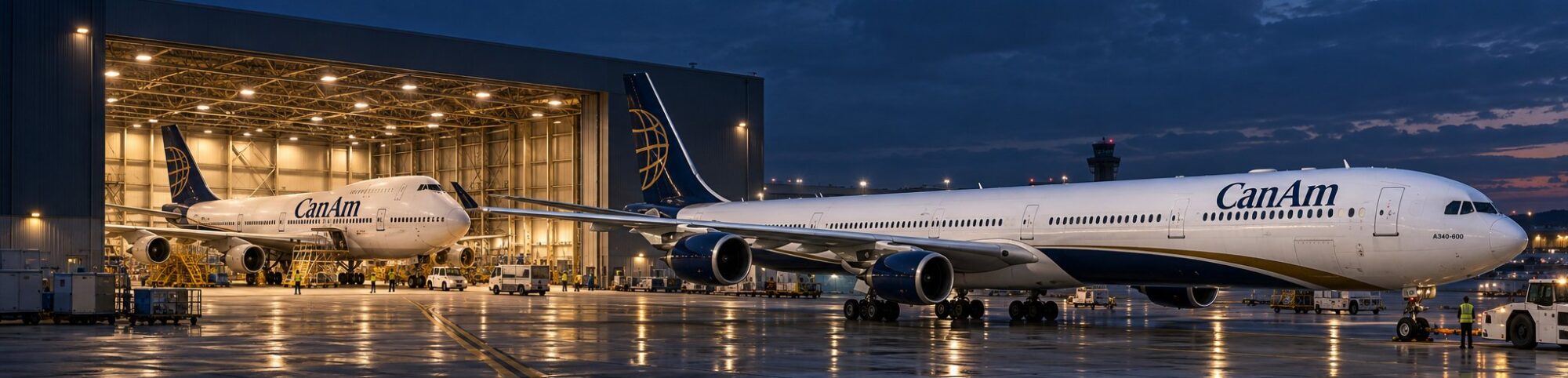
Proven Widebody Aircraft for a Staged Fleet Strategy
CanAm Airways is being developed around a staged widebody fleet strategy. The project does not depend on acquiring and operating its final fleet from day one.
During the initial ACMI phase, Airbus A340-600 aircraft are intended to provide the intercontinental range, cabin volume, cargo capacity, and operational platform required to introduce and validate the CanAm corridor.
This allows the project to begin with established aircraft, crews, maintenance, insurance, and operational control provided by an experienced ACMI operator.
Moving Toward CanAm’s Own Fleet
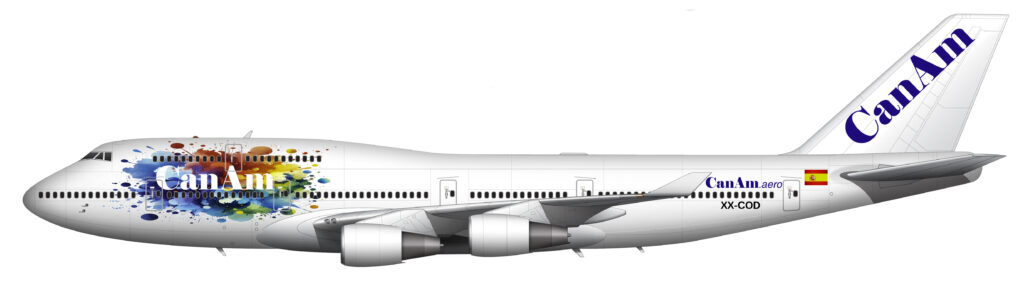
The longer-term strategy centers on Boeing 747-400 aircraft as the foundation of a dedicated CanAm fleet and a future European AOC operation.
The Boeing 747-400 combines intercontinental range, substantial passenger capacity, large cargo volume, and the cabin flexibility required for CanAm’s planned First Class and Atlantic Class product.
CanAm does not evaluate an aircraft by fuel consumption or fleet age in isolation. The central question is which aircraft can produce the strongest return on total capital employed while meeting the operational requirements of the network.
The fleet strategy centers on Boeing 747-400 aircraft, selected for their unique combination of range, structural robustness and large-volume capability. Rather than optimizing for fleet modernity alone, CanAm optimizes for system resilience.
Widebody aircraft with four-engine redundancy provide operational flexibility on long overwater segments (ETOPS), allow higher dispatch reliability in remote regions and offer unmatched cargo capacity alongside premium passenger configurations.
A pragmatic aircraft strategy
The selective use of pre-owned widebody aircraft can substantially reduce initial capital expenditure while providing access to mature maintenance systems, established spare-parts supply, and well-understood technical characteristics.
This approach can provide:
• lower acquisition costs
• earlier fleet availability
• established maintenance procedures
• access to existing technical expertise
• scalable fleet-development options
Any aircraft introduced into the CanAm fleet would remain subject to complete technical due diligence, maintenance-status verification, refurbishment requirements, and regulatory approval.
Engineering-Driven Decisions
Aircraft and configuration decisions are evaluated through measurable technical and commercial parameters:
• payload and range capablity
• passenger and cargo capacity
• Engine and spare-parts availability
• Maintenance requirements
• dispatch reliability
• airport and route compatability
• total operating economics
Each factor is assessed as part of the complete operating system, not as an isolated aircraft specification.
Passenger and Cargo Integration
CanAm’s widebody aircraft are intended to combine spacious premium passenger cabins with substantial lower-deck cargo capacity within the same route structure.
This is a fundamental distinction from long-range single-aisle aircraft such as the Airbus A321XLR and Boeing 757-300. These aircraft can carry passenger baggage and limited freight, but their restricted hold volume, baggage requirements, and long-range operating constraints leave far less to no capacity for commercial cargo.
They cannot provide the same combination of premium passenger space, containerized lower-deck capacity, and long-haul payload flexibility offered by the Airbus A340-600 and Boeing 747-400.
CanAm’s widebody platform can therefore accommodate First Class and luxurious Atlantic Class configurations while carrying commercial cargo between North America, the Canary Islands, and selected African markets on the same rotation.
Cargo is not treated as incidental revenue. It is integrated into route selection, scheduling, aircraft utilization, and the overall economics of each flight.
Environmental perspective
Older widebody aircraft consume more fuel per flight hour than current-generation aircraft. CanAm does not disregard this disadvantage.
Fuel consumption and emissions are evaluated against passenger capacity, cargo payload, achieved load factors, routing efficiency, and total aircraft utilization. Actual operating data from the launch phase will also contribute to future fleet-transition decisions.