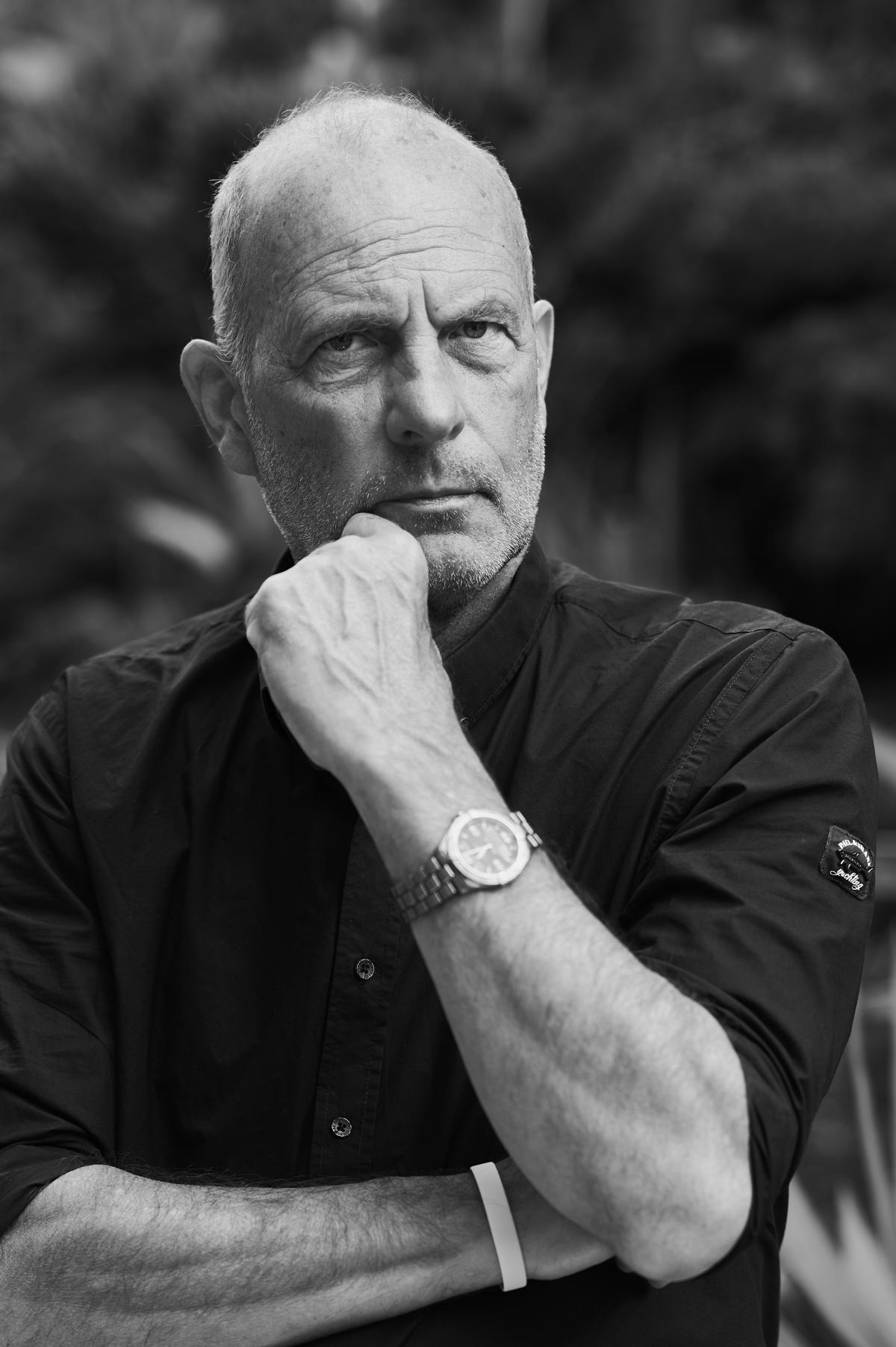
Klaus J. Lauth, Founder, CanAm Airways
CanAm Airways is not the product of a lifelong ambition to run an airline. It is the result of an engineer examining an overlooked geographic opportunity and asking whether aircraft, markets, cargo, infrastructure and timing could be brought together as one functioning system.
Klaus was born in Indonesia in 1961 and raised between cultures, continents and technical worlds. Now a German mechanical engineer and management consultant, he has spent his professional career at the intersection of industrial infrastructure, aircraft engineering, energy systems, automation, data centers, logistics and strategic project development.
This combination shaped the way CanAm was conceived: not as a collection of routes, but as an integrated aviation platform in which every major component must support the economics of the complete system.
His connection to aviation did not begin with a route map, an investor presentation or an airline brand.
It began on the workshop floor.
Engineering and Aviation Foundations
In 1988 and 1989, during his mechanical-engineering studies, he worked at Liebherr Aerotechnik in Lindenberg, one of the principal systems suppliers to Airbus.
He was involved in the assembly and 100 percent testing of Airbus components, including flap and slat mechanisms, gearboxes, position-pick-off units, wing-tip brakes, power-control units and air-conditioning packs.
Around 2001, he undertook development work for Impulse Aircraft. This included a lightweight retractable landing-gear concept operated by a single electric spindle actuator, as well as an AeroDiesel concept for the Impulse 100, combining a modern Subaru diesel engine with a redundant toothed-belt PSRU
-a propeller-speed transmission unit.
Neither concept failed for technical reasons. Limited investment and commercial constraints prevented their implementation in the final aircraft configuration. Nevertheless, the work anticipated themes that would later become increasingly relevant in aviation: mechanical simplification, lightweight systems, propulsion integration and operational reliability.
This was an early and formative exposure to an aircraft environment in which precision, documentation, redundancy, repeatability and quality discipline are not abstract ideals, but operational necessities.
Aviation was not romance. It was tolerance chains, test procedures, traceability and responsibility.
Complex Infrastructure and Industrial Systems
His subsequent industrial career added scale and systems integration to this technical foundation. It included major industrial and infrastructure projects, most prominently the fully automated Mercedes-Benz and SMART paint facility in Hambach, France, and the Injazat Data Systems Data Center in Abu Dhabi, where he served as Chief Coordination Engineer during development and commissioning within a Tier-IV-oriented environment.
These projects required the coordination of electrical power, cooling, fire protection, automation, control systems, data interfaces, contractors, documentation and operating procedures under considerable technical, scheduling and commercial pressure.
Further aviation- and airport-related assignments followed in Abu Dhabi. In the STRATA / IPAC environment, he supervised Airbus-related component handling, packaging and shipment logistics. In an early phase of the Abu Dhabi Airport Midfield Terminal Complex, he contributed through SCADIA to the strategic and technical framing of airport infrastructure.
A fully automated production facility, a mission-critical data center and an international airport may appear to be very different projects. Yet they share the same fundamental requirement:
Every individual system must perform – but the success of the complete project is determined at the interfaces between them.
Strategic and Management Experience
Mr. Lauth’s career also extended into management consulting. Among others, he worked for Management Engineers in Düsseldorf, a German strategy and operations consultancy later integrated into PwC Strategy&.
His assignments involved major industrial and automotive companies, including BMW, Volkswagen, Škoda, Webasto and Würth. This work added commercial analysis, operational strategy and the systematic testing of assumptions to his engineering background.
During his years in Dubai and Abu Dhabi, he also developed and presented strategic aviation considerations to senior Etihad Airways management concerning the carrier’s access to Germany and the wider European market. These considerations included traffic rights, airport access and Berlin-related slot positions at a time when differentiated access to Germany held considerable strategic value in Etihad’s competition with Emirates.
Etihad’s subsequent investment in Air Berlin publicly demonstrated the wider strategic importance of market access, traffic rights and airport positions. For Mr. Lauth, it reinforced a central lesson:
For Mr. Lauth, it reinforced a central lesson:
In aviation, the aircraft is only one part of the equation. Market access, airport position, traffic rights, slots and political timing can be just as decisive.
Over time, a clear pattern emerged. Engineering taught him to respect technical limitations. Infrastructure projects taught him to control interfaces. Consulting taught him to challenge assumptions. Aviation demonstrated that scale, access and timing determine whether an idea remains interesting – or becomes operational.
An Airline Concept Built Like an Engineering Project
He did not approach CanAm as a dreamer searching for numbers to justify an idea. He approached it as an engineer determined to establish whether the complete system could work.
That discipline is reflected in a comprehensive business-case model incorporating more than 100 operational, commercial, technical and financial parameters.
Aircraft costs, fuel consumption, maintenance reserves, crew rotations, route hours, passenger yields, load factors, cargo capacity, airport charges and cabin configuration are examined together – right down to the cost of the last meal served on board.
Different scenarios are tested against one another to expose dependencies, break-even thresholds, capital requirements and weaknesses before they become expensive operational realities.
The purpose is not to pretend that the future can be predicted with certainty. It is to make assumptions visible, risks measurable and the consequences of every major decision more predictable.
CanAm did not begin with a slogan. It began with a spreadsheet – and that spreadsheet had to withstand the scrutiny of an engineer.
For Mr. Lauth, CanAm Airways is therefore not a sudden departure from his previous work. It is the result of it.
The project is shaped by engineering discipline, infrastructure thinking, aviation experience and strategic consulting – together with the conviction that overlooked geographic positions can become powerful aviation platforms when aircraft, market access, airport infrastructure and timing are brought into alignment.